Aadi sale discount off 50%! Shop Now Free shipping on orders above ₹999! Learn More New arrivals just dropped. Explore Collection

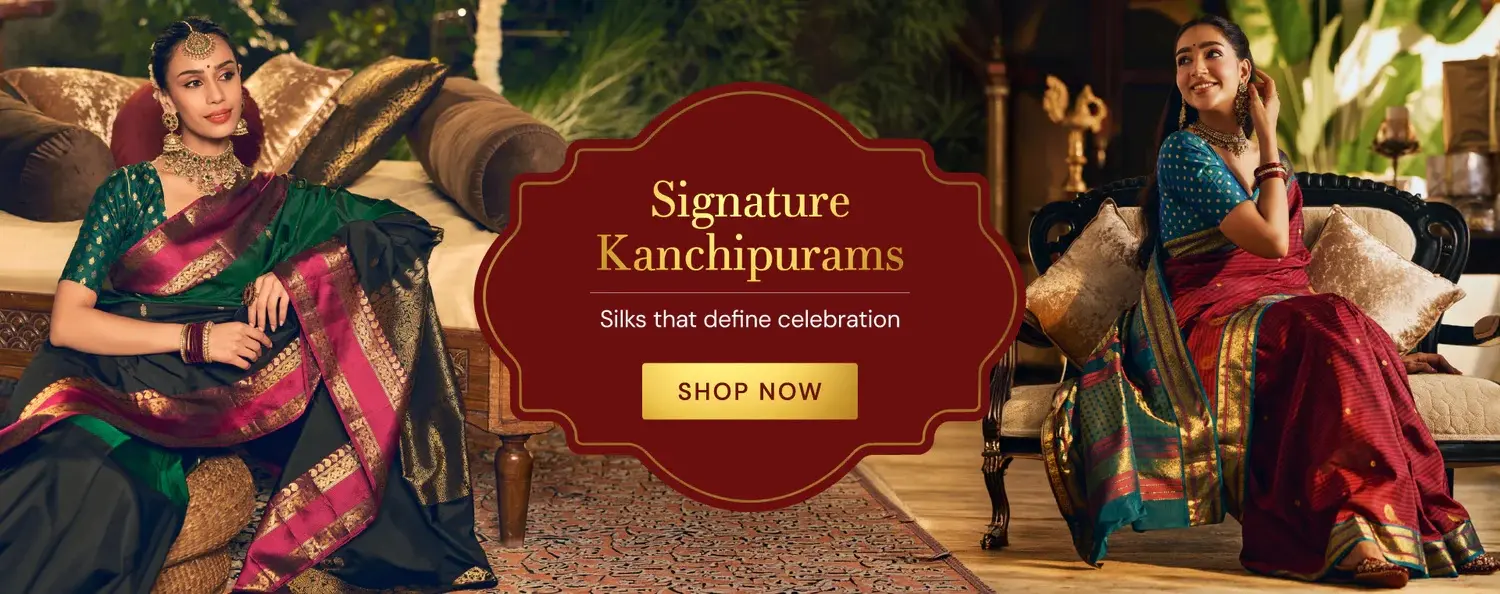
Kanjivaram, Banarasi, Patola: A Regional Tour of India's Most Iconic Silk Weaves
Jul 27, 2026
By
Padmanaban
0 comment(s)
Lay a Kanjivaram, a Banarasi, and a Patola side by side and you'd be forgiven for thinking three different countries made them. Same raw material — silk — and almost nothing else in common. The technique, the rhythm of the loom, the time it takes, even the families who weave them, are worlds apart. Here's what actually separates the three, and how to spot each one at a glance.
[IMAGE PLACEHOLDER 1 — Three sarees laid side by side: a Kanjivaram, a Banarasi, and a Patola, showing the contrast in pattern and texture]
Kanjivaram: The Silk of Temples and Legacy
Kanjivaram (or Kanchipuram) silk comes from a single temple town in Tamil Nadu, and it wears its origins openly — borders inspired by gopurams, the towering gateways of South Indian temples, and a weight and stiffness that make the saree feel less like fabric and more like armor built for celebration.
What sets a Kanjivaram apart structurally is korvai: a three-shuttle technique where the body and the border — frequently in two completely contrasting colors — are woven separately and interlocked at the join, strand by strand, rather than stitched or printed on afterward. Done well, the join is nearly invisible from the front, but strong enough that the saree can outlive the person who bought it.
The zari — the metallic thread woven through the border and pallu — is traditionally silver wire electroplated with gold, sourced from Surat. A quick, informal way to sense authenticity: real zari has a slight weight and a duller, warmer gleam than the bright, feather-light imitation zari used in machine-made copies.
Best suited for: weddings, temple visits, and pieces you intend to hand down rather than wear out.
[IMAGE PLACEHOLDER 2 — Close-up of a Kanjivaram temple border and korvai join, showing the contrast color-blocking]
Banarasi: Where Persia Met the Ganges
Banarasi silk carries its history in its patterns. Varanasi's weavers absorbed Mughal court aesthetics centuries ago, and it shows — paisleys (kalga), dense floral jaals, and brocade work that looks closer to embroidery than weaving, even though every motif is built thread by thread on the loom.
Unlike Kanjivaram's bold color-blocking, Banarasi's signature is subtlety and density. Techniques like kadhwa (motifs woven individually and cut close, giving a raised, embroidered look) and tanchoi (a technique borrowed and adapted from Chinese weavers, producing satin-smooth, richly patterned fabric without a heavy zari load) show just how many different "Banarasi" actually means. A true Banarasi can take anywhere from two weeks to over a month, depending on how elaborate the brocade is.
Where Kanjivaram is architectural, Banarasi is closer to a painting — meant to be read up close, motif by motif.
Best suited for: bridal trousseaus, receptions, and occasions where you want intricacy over boldness.
[IMAGE PLACEHOLDER 3 — Close-up of Banarasi brocade motifs, showing the floral/paisley detail and zari work]
Patola: The Double Ikat Miracle
Patola is the quiet outlier of the three, and arguably the most technically demanding textile in India. Woven only in Patan, Gujarat, it uses double ikat — both the warp and the weft threads are individually tie-dyed in the exact sequence needed to form the final pattern before a single thread touches the loom. The weaver isn't creating the pattern at the loom; they're aligning two pre-dyed sets of thread so precisely that the design appears, matching perfectly, on both sides of the fabric.
There is no embroidery, no printing, and no room for error — a single misaligned thread can throw off the entire pattern. A single Patola saree can take anywhere from six months to over a year to complete, and for centuries it was woven by only a handful of families, making it as much a historical artifact as a garment. Patola sarees were once traded as far as Indonesia, where they were treated as royal heirlooms in their own right.
Patterns tend to be geometric or figurative — parrots, elephants, dancers, and flowers — arranged in tight, symmetrical repeats that look almost too precise to be handmade.
Best suited for: serious collectors, heirloom purchases, and anyone who wants a piece of textile history rather than "just" a saree.
[IMAGE PLACEHOLDER 4 — Patola double ikat pattern close-up, showing the geometric precision on both sides of the fabric]
Telling Them Apart at a Glance
- Kanjivaram: heavy, stiff drape; bold contrasting border; visible korvai join line.
- Banarasi: softer drape; dense, painterly brocade; motifs read like a miniature painting.
- Patola: geometric, slightly blurred-edge patterns (a signature of ikat dyeing); identical design on both faces of the fabric.
None of these techniques has a real machine equivalent — not because machines couldn't attempt it, but because the decisions involved (which shuttle, which knot, which thread to shift by a millimeter) are made by a weaver reading the fabric as they go, not following a fixed program.
Beyond the Big Three
Kanjivaram, Banarasi, and Patola get the most attention, but they're far from the whole map. Chanderi's sheer, coin-motif silk-cotton blends, Paithani's peacock-pallu weaves, and Baluchari's mythological storytelling borders each deserve their own deep dive — and we'll get there in future posts.
Every one of these traditions lives on in the hands of a shrinking number of weaving families. Explore our silk saree collection to see how each technique translates into a piece you can actually wear.